Garage Door Sensors Not Working in Miami? Fix Checklist
Garage door sensors not working in Miami? Follow a simple checklist for cleaning, aligning and checking photo eyes, and learn when to call a pro.
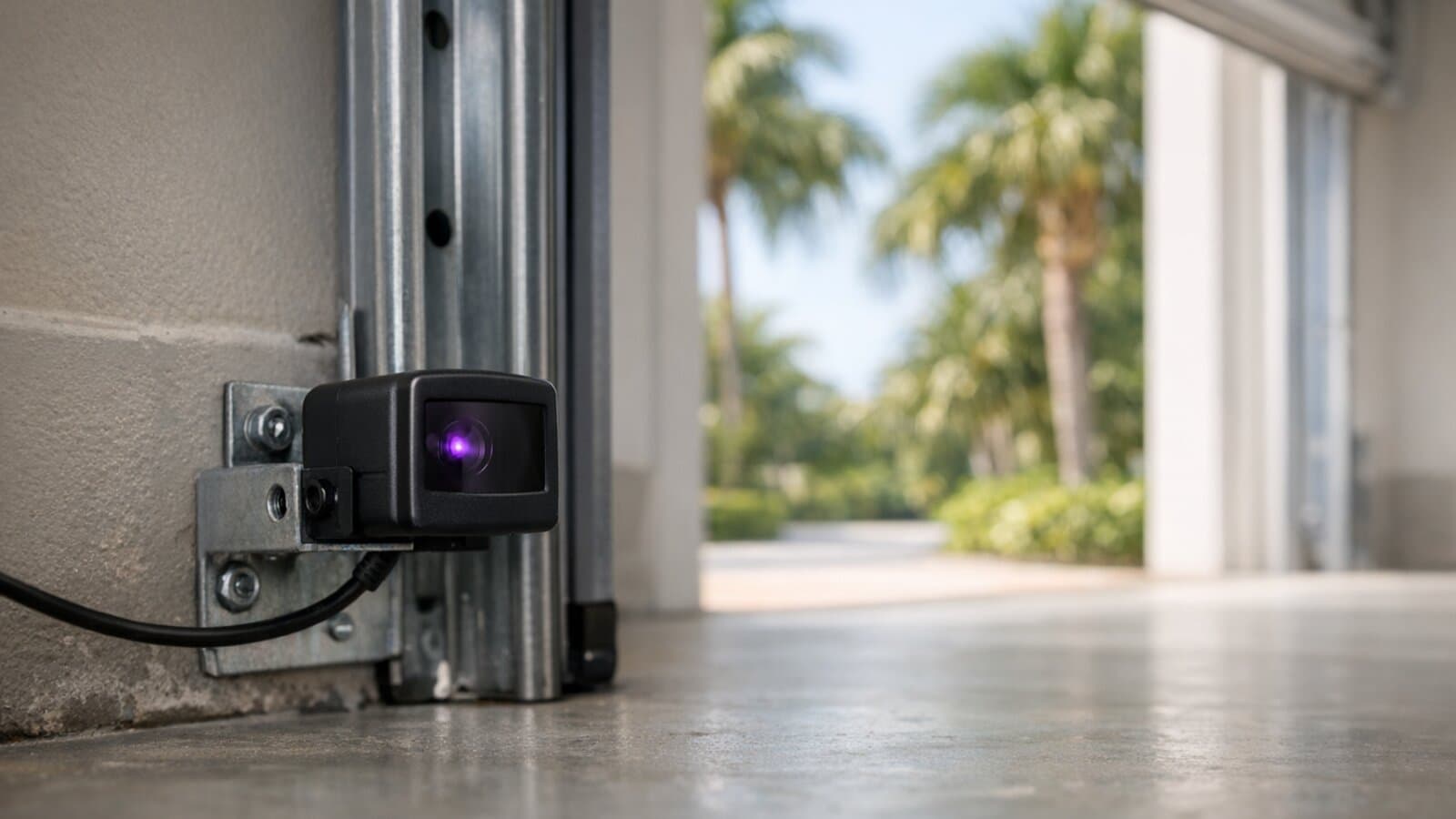
You press the remote, the opener hums, the door starts down, and then it stops and reverses. Or it refuses to close at all while a light blinks on the motor. If your garage door sensors are not working in Miami, the cause is usually small: a dusty lens, a bumped bracket or a loose wire. The good news is that you can check most of it yourself in a few minutes.
This guide explains what the sensors do, why Miami's weather seems to knock them out, a step-by-step checklist you can follow safely, and when it's time to call a professional.
What Garage Door Sensors Actually Do
The two small units mounted near the floor on either side of your door are the safety sensors, often called photo eyes. One sends an invisible beam, the other receives it. If something crosses the beam while the door is closing, the opener is told to stop and reverse.
According to the U.S. Consumer Product Safety Commission (CPSC), external entrapment protection was added to openers in 1993, and if an electric eye is the chosen system it should be installed 4 to 6 inches above the floor. That low placement is deliberate: it protects children, pets and anything else that ends up in the door's path.
Because the sensors are part of the opener's safety system, the opener is designed to refuse to close the door normally when it can't confirm the beam is clear. That's why a failed sensor feels like a dead opener even when the motor is fine.
Signs Your Garage Door Sensors Are Not Working
- The door closes a few inches, then goes back up. This is the classic symptom of a blocked or misaligned beam.
- The opener light blinks several times when you press the button and the door won't move down.
- One sensor light is off or flickering. Most units have a small indicator on each side, so a dark or unsteady light points to power or alignment trouble.
- It works in the morning and fails in the afternoon. Direct sun hitting a lens can confuse the receiver.
- The door only closes while you hold the wall button down. That usually points to a sensor fault. Don't rely on it as a workaround.
Why Miami Is Hard on Sensors
Sensors sit close to the ground, right where humidity, splashing rain and sprinkler overspray end up. Common local causes include:
- Moisture and condensation inside the lens housing or on the wire connectors.
- Salt air and corrosion on terminals, screws and mounting brackets, especially closer to the coast.
- Lawn and palm debris, spider webs and insects that settle in the small lens opening.
- Direct sunlight at certain times of day, which can wash out the beam.
- Storm and wind movement that nudges a bracket slightly out of position.
- Wiring damage from trimmers, pressure washers or stored items bumped against the wall.
If you want the bigger picture on how our climate wears out door hardware, our post on garage door maintenance in Miami covers the routine that keeps small problems small.
Garage Door Sensors Not Working in Miami: A Step-by-Step Checklist
Work through these in order. Keep your hands, tools and ladder clear of the door's path, and never put any part of your body under a closing door.
- Look for an obvious obstruction. Boxes, tools, a bike wheel or a hose near the sensors can block the beam.
- Check the indicator lights. Note whether both sensors are lit and steady, one is dark, or one is blinking.
- Wipe both lenses with a soft, dry or barely damp cloth. Wipe away cobwebs and dried dirt, and let the area dry before testing.
- Look at the brackets. Each sensor should sit at the same height and point straight across at the other. A bracket that has been bent or loosened by a bump is a very common culprit.
- Gently realign. If a sensor is crooked, adjust it slowly until its indicator light goes steady, then snug the mounting hardware.
- Check the wires. Unplug the opener or switch off its power first. Then follow the thin wire from each sensor to the opener. Look for cuts, pinched sections, loose connectors and green or white corrosion on terminals.
- Shade the lens if sun is the issue. A simple shield or hood can reduce glare, but don't block the beam itself.
- Test with the door clear. Press the wall button and watch the door close. Then place a rolled-up towel or a cardboard box in the path, away from your body, and confirm the door reverses.
The CPSC also recommends testing the opener's reverse function with a 2x4 in the door's path, and inspecting the door and opener every 30 days. If the door doesn't reverse, disengage the opener and get it repaired.
What Not to Do
It can be tempting to bypass the problem. Please don't:
- Don't disconnect or tape over the sensors. That removes a safety feature that protects people and pets.
- Don't rely on holding the button down as a long-term fix.
- Don't force the door by hand while it's still connected to the opener if it feels heavy or uneven. A door that's out of balance, or has a damaged spring or cable, is a different and more dangerous problem. Our guide to a garage door that's off track in Miami explains why to leave that to a professional.
When Sensor Trouble Points to a Bigger Problem
Sometimes the sensors are only the messenger. Call a professional if:
- Both sensors are lit and aligned, but the door still won't close.
- The wiring looks damaged or corroded along its whole length.
- The opener is old and failing in several ways at once. At that point, garage door opener replacement in Miami may make more sense than another repair.
- The door reverses or stops even with no obstruction and no sensor issues, which can point to travel or force settings, or to a door that has mechanical trouble.
- You're not comfortable working near the door, the opener or the wiring.
A technician can test the sensors, replace corroded wiring or damaged units, and check that the full safety system, including the reverse function, works as intended. Our garage door repair team handles these calls across Miami-Dade County.
Garage Door Sensors FAQ
Why does my garage door close and then go back up?
The opener is most likely detecting something in the beam's path, or the sensors are misaligned. Check for debris, dirty lenses and bent brackets first.
Can I bypass garage door sensors?
You shouldn't. They're a safety feature, and per the CPSC, openers made since the 1993 change include entrapment protection. If they're failing, fix or replace them instead.
Do the sensors need to be exactly the same height?
They should be mounted at the same height and aimed straight at each other. The CPSC says an electric eye should be installed 4 to 6 inches above the floor.
Can rain make the sensors stop working?
Yes. Moisture on the lens or in wire connections can interrupt the signal. Dry the lenses, check the connectors and look for corrosion.
How often should I check my sensors?
The CPSC recommends inspecting your garage door and opener every 30 days. A quick look at the lenses and indicator lights is an easy addition to that routine.
Need Help With Your Garage Door Sensors?
If you've cleaned, aligned and checked the wiring and the door still won't close properly, we're happy to take a look. Get a free quote or call (786) 395-4042 and we'll help you get your opener working safely again.